
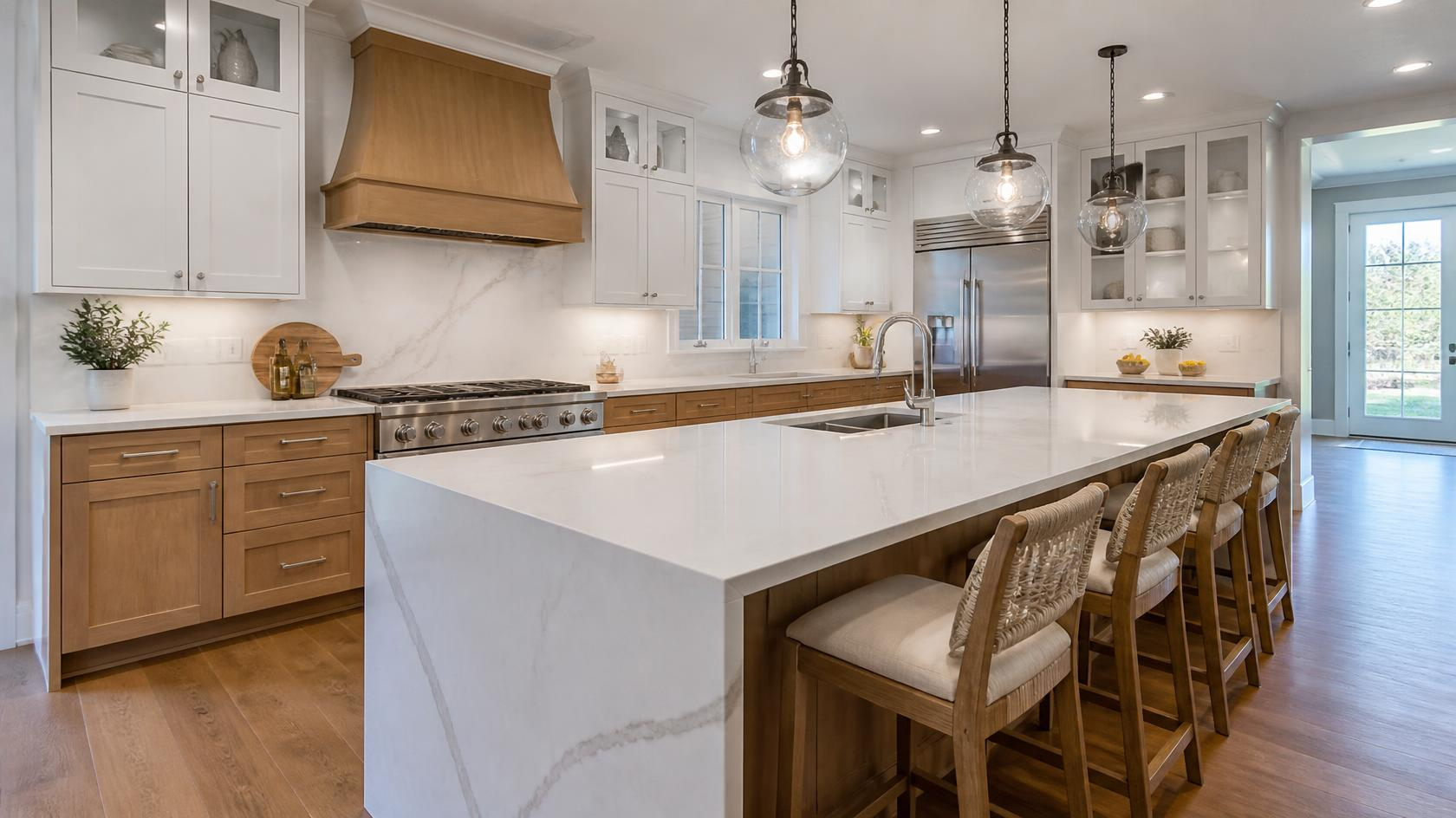
Choosing quartz countertops isn’t only about durability and maintenance. Color can completely transform the appearance of your kitchen.
The right countertop can make a small kitchen feel brighter, create contrast with cabinetry, highlight a large island, or bring warmth to a modern interior.
Quartz offers one of the widest selections of colors and patterns available in the countertop industry. From clean white surfaces to dramatic marble-inspired veining, homeowners can find options for nearly every design style.
But with so many choices available, selecting the right one can quickly become overwhelming.
In this guide, we’ll explore some of the best quartz countertop colors for modern kitchens, along with practical advice for pairing quartz with cabinets, flooring, backsplashes, and the architectural character found in Massachusetts homes.
Quick Answer
Some of the most versatile quartz countertop colors for modern kitchens include:
- White
- White with gray veining
- Warm white
- Cream
- Beige
- Light gray
- Charcoal
- Black
- Marble-inspired patterns
The best choice depends on your cabinets, flooring, lighting, kitchen size, and overall design style.
Neutral quartz tends to provide the greatest flexibility because it can adapt to future changes in cabinetry, paint colors, and décor.
White Quartz: Clean and Timeless
White quartz remains one of the most versatile countertop choices.
It reflects light beautifully and can make kitchens feel brighter, larger, and cleaner.
White quartz works especially well with:
- White cabinets
- Navy cabinets
- Black cabinets
- Natural wood
- Sage green
- Gray cabinetry
For minimalist interiors, homeowners can choose a nearly solid white surface.
For more character, subtle gray or beige veining adds movement without overwhelming the space.
White Quartz with Gray Veining
For homeowners who love the appearance of marble but want easier everyday maintenance, white quartz with gray veining is an extremely popular option.
This style can create a sophisticated focal point while maintaining a bright overall appearance.
It works particularly well for:
- Large kitchen islands
- Waterfall edges
- Full-height backsplashes
- Contemporary kitchens
- Transitional interiors
The amount of veining matters.
Fine veins create a subtle appearance, while dramatic patterns turn the countertop into a statement feature.
Warm White Quartz
Not every white countertop needs to have cool undertones.
Warm white quartz contains subtle cream, beige, or gold undertones that create a softer atmosphere.
This is especially useful in homes with:
- Warm hardwood flooring
- Cream cabinets
- Brass hardware
- Natural oak
- Traditional millwork
- Warm interior lighting
Warm whites can complement the character of older New England homes while still creating an updated kitchen.
Beige and Cream Quartz
Beige is returning to kitchen design—but today’s versions are far more sophisticated than the yellow-heavy beige surfaces associated with older interiors.
Modern beige quartz often includes:
- Soft taupe
- Warm cream
- Subtle brown
- Delicate gold veining
- Natural stone-inspired patterns
These surfaces create warmth without making a kitchen feel dated.
They’re particularly effective when paired with natural wood cabinetry.
Light Gray Quartz
Light gray quartz offers an excellent middle ground between bright white and darker surfaces.
It’s modern without feeling overly dramatic.
Gray quartz pairs beautifully with:
- White cabinets
- Charcoal cabinets
- Navy blue
- Light wood
- Stainless steel appliances
It’s also practical for homeowners who want a neutral surface that doesn’t show every small crumb or mark as easily as some solid white or black finishes.
Charcoal Quartz
Dark gray and charcoal countertops can create a sophisticated modern kitchen.
They’re especially effective when used as a contrast against lighter cabinetry.
For example:
White cabinets + charcoal quartz + warm hardwood floors
creates a balanced interior with strong visual contrast.
Charcoal quartz can also work beautifully on a kitchen island while lighter countertops are used around the perimeter.
Black Quartz
Black quartz creates one of the strongest design statements.
It can make a kitchen feel dramatic, luxurious, and architectural.
Popular combinations include:
- Black quartz + white cabinets
- Black quartz + natural oak
- Black quartz + walnut cabinets
- Black quartz + brass hardware
However, lighting is important.
In a small kitchen with limited natural light, too much black can make the room feel smaller.
Strategic contrast often works better than using dark surfaces everywhere.
Marble-Look Quartz
Marble-inspired quartz is one of the most popular categories because it combines dramatic stone aesthetics with easier everyday maintenance.
These designs typically feature a white or cream background with:
- Gray veins
- Gold veins
- Warm taupe movement
- Bold dramatic patterns
The result can resemble luxury natural stone while offering the practical benefits associated with engineered quartz.
Subtle vs. Dramatic Veining
One of the biggest design decisions isn’t necessarily the countertop color—it’s the amount of movement.
Subtle veining works well when:
- Cabinets are visually detailed.
- The backsplash has a strong pattern.
- The kitchen has many decorative elements.
- You want a timeless appearance.
Dramatic veining works well when:
- The kitchen design is minimalist.
- The island is the focal point.
- Cabinetry is simple.
- You’re creating a luxury statement.
Balance is the key.
Not every element in the kitchen should compete for attention.
Best Quartz Colors for White Cabinets
White cabinets provide enormous flexibility.
Almost any quartz color can work, but some combinations are especially effective.
| Quartz Color | Overall Look |
|---|---|
| White with Gray Veins | Bright & Elegant |
| Warm White | Soft & Timeless |
| Light Gray | Modern & Balanced |
| Beige | Warm & Inviting |
| Charcoal | Strong Contrast |
| Black | Dramatic & Contemporary |
For an all-white kitchen, subtle veining can prevent the space from feeling flat.
Best Quartz Colors for Wood Cabinets
Natural wood has become increasingly prominent in modern kitchen design.
Quartz can either complement the warmth of the wood or create intentional contrast.
For light oak cabinets, consider:
- Warm white
- Cream
- Soft gray
- Beige
- White with gold or taupe veining
For darker walnut cabinetry, consider:
- Bright white
- Warm white
- Light gray
- Cream marble-look quartz
The contrast helps showcase the natural grain of the wood.
Best Quartz Colors for Dark Cabinets
Dark cabinetry creates a sophisticated backdrop for lighter countertops.
Popular combinations include:
Navy cabinets + white quartz
Charcoal cabinets + marble-look quartz
Black cabinets + warm white quartz
These combinations create contrast while keeping the kitchen visually balanced.
Should the Island Match the Other Countertops?
Not necessarily.
Using a different quartz color on the island can create a focal point.
For example:
Perimeter: White quartz
Island: Charcoal quartz
Or:
Perimeter: Subtle white quartz
Island: Dramatic marble-inspired quartz
This approach works especially well in large kitchens where the island is a major architectural feature.
Should Your Quartz Match the Backsplash?
Your countertop and backsplash should coordinate—but they don’t need to match exactly.
A heavily veined quartz usually works best with a simpler backsplash.
A subtle countertop allows more freedom to introduce texture or pattern on the wall.
Another luxury option is using the same quartz material as a full-height backsplash.
This creates a continuous stone appearance with fewer visual interruptions.
Don’t Forget Your Flooring
Flooring occupies a large portion of the visual field and can strongly influence countertop selection.
Before choosing quartz, compare the slab against your flooring.
Look for compatible undertones.
For example:
Warm hardwood often pairs better with warm white, cream, beige, or quartz containing subtle gold movement.
Cool gray flooring may work better with white, gray, charcoal, or cool-veined surfaces.
How Lighting Changes Quartz Colors
Quartz can look surprisingly different depending on lighting.
A surface that appears bright white in a showroom may look warmer inside your home.
Always consider:
- Natural daylight
- Pendant lighting
- Recessed lighting
- Cabinet lighting
- Window orientation
Whenever possible, evaluate samples inside the actual kitchen before making the final decision.
Which Quartz Colors Make a Kitchen Look Bigger?
Light surfaces generally reflect more light and can make compact kitchens feel more open.
Good options include:
- Bright white
- Warm white
- Cream
- Very light gray
- Subtle marble-look quartz
Combining light countertops with lighter cabinetry can further enhance this effect.
Which Quartz Colors Hide Everyday Mess Best?
Extremely solid surfaces—particularly pure black or pure white—can sometimes make crumbs, fingerprints, or water spots more noticeable.
Quartz with subtle movement or veining tends to disguise everyday marks more effectively.
For busy family kitchens, consider:
- Soft gray
- Warm white with veining
- Beige
- Light stone-inspired patterns
These provide an excellent balance between appearance and practicality.
What Quartz Colors Are Best for Massachusetts Homes?
Massachusetts has an unusually diverse housing stock, ranging from traditional Colonial and Cape-style homes to contemporary residences and urban renovations.
For traditional homes, timeless combinations often work best:
- Warm white quartz
- Cream quartz
- Soft marble-inspired patterns
- Light gray
- Subtle beige
For contemporary homes:
- Dramatic white veining
- Charcoal
- Black
- Waterfall quartz islands
- High-contrast combinations
The goal shouldn’t be to force a trend into the home. The countertop should complement the architecture and overall interior design.
Will Trendy Quartz Colors Become Outdated?
They can.
Strong patterns and unusual colors may look exciting today but can become more difficult to coordinate when other elements of the kitchen change.
If long-term versatility or resale appeal is important, neutral colors are generally safer.
You can introduce trends through elements that are easier to replace, such as:
- Paint
- Hardware
- Lighting
- Bar stools
- Decorative accessories
Countertops are a longer-term investment.
View the Full Slab Before Choosing
This is one of the most important steps in countertop selection.
A small quartz sample doesn’t always represent the complete pattern of a slab.
This is particularly important with dramatic veining.
Viewing the full slab allows you to evaluate:
- Pattern scale
- Vein direction
- Color variation
- Overall movement
- Potential island placement
It also helps your fabricator plan how the most attractive portions of the slab will appear in the finished kitchen.
Fabrication Can Affect the Final Design
Choosing a beautiful quartz slab is only the beginning.
Professional fabrication determines how the pattern flows through your kitchen.
This becomes especially important around:
- Islands
- Corners
- Seams
- Waterfall edges
- Sink openings
- Cooktops
With strongly veined quartz, thoughtful slab layout can dramatically improve the final appearance.
Why Choose Accurate Pro Countertops?
At Accurate Pro Countertops, we help Massachusetts homeowners choose countertop materials that complement their kitchens—not simply follow temporary trends.
Our team can help you evaluate quartz colors alongside your:
- Cabinets
- Flooring
- Backsplash
- Kitchen layout
- Lighting
- Design preferences
Once you’ve selected your material, our experienced team handles professional templating, custom fabrication, and installation.
The result is a countertop designed specifically for your space.
Frequently Asked Questions
What is the most popular quartz countertop color?
White and white-based quartz with subtle gray or warm veining remain among the most versatile choices because they complement many cabinet colors and kitchen styles.
What quartz color looks best with white cabinets?
White cabinets work with almost everything. Marble-inspired white quartz creates an elegant look, while charcoal or black quartz provides stronger contrast.
What quartz color looks best with wood cabinets?
Warm white, cream, beige, and soft gray quartz often complement natural wood beautifully.
Are dark quartz countertops difficult to maintain?
Not necessarily, but some very dark solid surfaces can make fingerprints, dust, and water spots more visible.
Should my kitchen island use a different quartz color?
It can. A contrasting island is an excellent way to create a focal point in a larger kitchen.
Does quartz look like real marble?
Modern quartz can reproduce marble-inspired colors and veining extremely well, although it remains an engineered material rather than natural marble.
Should countertops be lighter or darker than cabinets?
Either approach can work. Contrast generally creates a stronger visual statement, while similar tones produce a softer, more uniform design.
Final Thoughts
Choosing among the best quartz countertop colors isn’t simply about selecting what’s popular today.
The right countertop should work with your cabinets, flooring, lighting, backsplash, architecture, and lifestyle.
White and marble-inspired quartz offer timeless versatility. Warm neutrals can create inviting kitchens. Gray provides a balanced contemporary appearance, while charcoal and black can produce dramatic contrast.
The best result comes from seeing the complete material and considering how it will interact with the entire room.
If you’re planning a kitchen renovation in Massachusetts, Accurate Pro Countertops can help you explore quartz options and select a surface that fits both your home and your personal style.
From material selection and professional templating to custom fabrication and final installation, our team is ready to help bring your kitchen design to life.