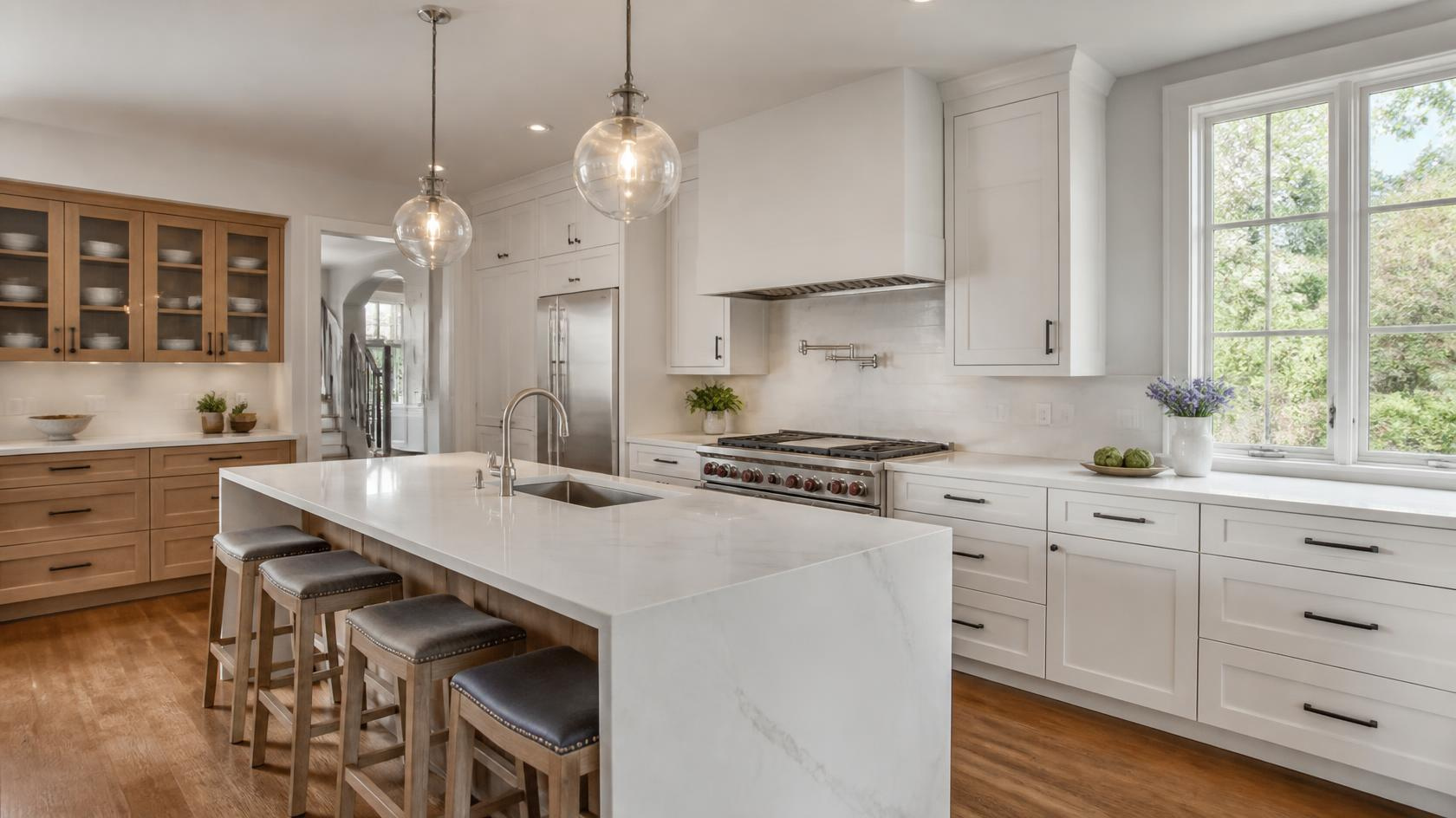
Quartz countertops have become one of the most popular choices for modern kitchens and bathrooms—and it’s easy to understand why.
They’re durable, stylish, available in hundreds of colors and patterns, and require significantly less routine maintenance than many natural stone surfaces.
But quartz isn’t perfect for every project.
Before investing in new countertops, homeowners should understand both the advantages and limitations of the material. Factors such as heat exposure, outdoor use, design preferences, budget, and everyday kitchen habits can all influence whether quartz is the right choice.
In this complete guide, we’ll explore the most important quartz countertops pros and cons to help Massachusetts homeowners make an informed decision.
Quick Overview: Quartz Pros and Cons
Here’s a simple comparison before we explore each factor in detail.
| Pros | Cons |
|---|---|
| Highly durable | Sensitive to excessive heat |
| Excellent stain resistance | Not completely natural stone |
| Non-porous surface | Some designs can be expensive |
| No routine sealing required | UV exposure can affect some products |
| Large variety of colors | Damage can be difficult to repair |
| Consistent appearance | Seams may be visible |
| Easy daily maintenance | Very heavy material |
| Excellent for busy kitchens | Outdoor use can be limited |
For many indoor kitchens and bathrooms, the advantages outweigh the disadvantages. However, understanding how you use your space is essential.
PRO #1: Quartz Is Extremely Durable
Durability is one of quartz’s greatest strengths.
Engineered quartz countertops are manufactured to create a dense, strong surface capable of handling normal daily kitchen activity.
They’re highly resistant to:
- Scratches
- Chips
- Everyday wear
- Food preparation
- Moisture
- Common household stains
That durability makes quartz especially attractive for busy family kitchens.
However, scratch-resistant doesn’t mean scratch-proof. Using cutting boards is still recommended.
PRO #2: Quartz Doesn’t Require Routine Sealing
This is one of the biggest differences between quartz and many natural stone countertops.
Granite and some other natural stones typically benefit from periodic sealing because they’re porous.
Engineered quartz is non-porous.
That means homeowners generally don’t need to schedule routine sealing to maintain the surface.
For people who want premium countertops with minimal maintenance, this is a major advantage.
PRO #3: Excellent Stain Resistance
Kitchens are messy.
Coffee gets spilled. Tomato sauce splashes. Wine glasses tip over.
Quartz handles many of these everyday situations extremely well because liquids aren’t easily absorbed into its non-porous surface.
Common spills can usually be cleaned using appropriate mild cleaning products and a soft cloth.
Still, spills should be cleaned promptly. No premium countertop should be treated as completely stain-proof.
PRO #4: Huge Variety of Designs
One of the reasons designers love quartz is its versatility.
Manufacturing technology allows quartz to be produced in an enormous range of appearances.
Popular options include:
- Bright white
- Warm white
- Soft gray
- Beige
- Black
- Concrete-inspired surfaces
- Marble-inspired patterns
- Dramatic veining
- Minimalist solid colors
This makes quartz easy to integrate into both traditional and contemporary interiors.
PRO #5: More Predictable Patterns
Natural stone is intentionally unpredictable.
Every granite or quartzite slab has unique movement, coloration, and veining.
Some homeowners love that uniqueness. Others want greater consistency.
Quartz offers more predictable patterns, making it easier to coordinate countertops with cabinets, flooring, backsplash tile, and other design elements.
This can be particularly useful in large kitchens where multiple slabs are required.
PRO #6: Easy Everyday Cleaning
Quartz maintenance is straightforward.
For everyday cleaning, homeowners typically need:
- A soft microfiber cloth
- Warm water
- Mild soap or an appropriate surface cleaner
Harsh chemicals and abrasive scrubbers should generally be avoided.
Because the surface is non-porous, everyday cleanup tends to be quick and convenient.
PRO #7: Excellent for Bathrooms
Quartz isn’t limited to kitchens.
Its low maintenance and moisture resistance make it an excellent choice for bathroom vanities.
Quartz works especially well for:
- Primary bathrooms
- Double vanities
- Guest bathrooms
- Powder rooms
- Custom vanity installations
Homeowners can also coordinate bathroom countertops with other surfaces throughout the house for a more consistent design.
PRO #8: Works with Many Kitchen Styles
Massachusetts homes vary dramatically in architecture.
A countertop that works in a Boston-area contemporary renovation may need to look completely different from one installed in a traditional Colonial-style home.
Quartz offers enough variety to complement both.
For traditional kitchens, subtle stone-inspired quartz can pair beautifully with shaker cabinetry and hardwood floors.
For modern spaces, large islands, waterfall edges, bold veining, and contrasting cabinetry can create a dramatic architectural statement.
CON #1: Quartz Can Be Damaged by Excessive Heat
Heat sensitivity is probably the most important limitation homeowners should understand.
Quartz contains binders used during manufacturing. Excessive heat can potentially damage or discolor the surface.
Avoid placing hot:
- Pots
- Pans
- Baking sheets
- Dutch ovens
- Small appliances that generate substantial heat
directly on the countertop.
Using trivets or heat-resistant pads is a simple way to protect the surface.
CON #2: Quartz Isn’t Completely Natural Stone
Quartz countertops contain natural mineral quartz, but the finished slabs are engineered products.
For many homeowners, that’s actually an advantage because it creates predictable designs and low maintenance.
However, someone specifically looking for a completely natural slab may prefer granite or quartzite.
Natural stone offers geological patterns that can’t be perfectly duplicated.
CON #3: Premium Quartz Can Be Expensive
Quartz isn’t necessarily the budget option.
Pricing varies based on:
- Manufacturer
- Collection
- Pattern
- Thickness
- Slab requirements
- Edge profile
- Fabrication complexity
- Installation
Premium designs featuring sophisticated veining can cost considerably more than entry-level quartz.
The material should therefore be evaluated based on the complete installed project—not simply the price of a slab.
CON #4: Not Every Quartz Is Suitable for Outdoor Kitchens
Traditional engineered quartz may not be ideal for prolonged exterior exposure.
UV radiation can affect the appearance of certain products over time.
For outdoor kitchens in Massachusetts, materials such as granite, quartzite, or outdoor-rated porcelain may be more appropriate depending on the project.
Always verify whether a specific quartz product is approved by its manufacturer for exterior applications.
CON #5: Repairs Can Be Difficult
Quartz is durable, but damage is still possible.
A strong impact near an edge or sink opening can potentially cause a chip.
Repairs may be possible, but achieving a perfect color and pattern match can sometimes be challenging.
Professional fabrication and proper support help minimize these risks from the beginning.
CON #6: Seams May Be Visible
Large kitchens may require more than one quartz slab.
When multiple slabs are necessary, seams become part of the fabrication plan.
An experienced fabricator will strategically position seams to minimize their appearance while maintaining structural integrity.
With heavily veined quartz, careful pattern alignment becomes even more important.
This is one reason the quality of the fabricator matters as much as the material itself.
Quartz vs. Granite: How Do the Pros and Cons Compare?
Quartz and granite are both premium countertop options, but their strengths are different.
| Feature | Quartz | Granite |
|---|---|---|
| Material | Engineered | Natural Stone |
| Sealing | Usually Not Required | Periodically Recommended |
| Stain Resistance | Excellent | Excellent When Sealed |
| Heat Resistance | Good | Excellent |
| Pattern Consistency | Excellent | Naturally Variable |
| Unique Slabs | Less Unique | Every Slab Is Unique |
| Maintenance | Very Low | Low |
| Outdoor Use | Product Dependent | Excellent |
| Design Variety | Excellent | Excellent |
There’s no universal winner.
The best countertop is the one that matches your lifestyle, design preferences, and intended application.
Who Should Choose Quartz?
Quartz may be an excellent choice if you:
- Want minimal maintenance.
- Have a busy family kitchen.
- Prefer consistent patterns.
- Want a marble-inspired look with easier care.
- Don’t want routine countertop sealing.
- Need excellent stain resistance.
- Want extensive color options.
For these homeowners, quartz provides an excellent combination of appearance and practicality.
Who Might Prefer Granite Instead?
Granite may be a better fit if you:
- Prefer authentic natural stone.
- Want every countertop to be completely unique.
- Frequently work around high heat.
- Are designing an outdoor kitchen.
- Love natural mineral variation.
- Prefer the character of quarried stone.
Both materials can create exceptional kitchens when they’re properly selected, fabricated, and installed.
What About Quartzite?
Quartz and quartzite are often confused because of their similar names, but they’re very different materials.
Quartz is engineered.
Quartzite is natural stone quarried from the earth.
Quartzite can offer dramatic natural movement and excellent durability, but its maintenance requirements vary depending on the specific stone.
Homeowners considering a luxury natural surface should compare granite, quartz, and quartzite before making their final decision.
Is Quartz a Good Choice for a Kitchen Island?
Yes—and large islands are one of the best applications for quartz.
A dramatic quartz pattern can transform an island into the visual centerpiece of the kitchen.
Popular island designs include:
- Waterfall edges
- Contrasting countertop colors
- Oversized seating areas
- Integrated sinks
- Statement veining
For large islands, slab dimensions and seam placement should be discussed before fabrication.
How to Choose the Right Quartz
Don’t choose quartz based only on an online image or a small sample.
Whenever possible, evaluate the complete slab.
Consider:
- Cabinet color
- Flooring
- Backsplash
- Natural lighting
- Artificial lighting
- Appliance finishes
- Kitchen size
- Vein direction
A countertop occupies a large visual area, so small differences in undertone can significantly affect the final design.
Why Fabrication Quality Matters
Premium quartz doesn’t automatically guarantee premium results.
Fabrication determines how the countertop actually fits and functions inside your home.
Professional countertop fabrication should include:
- Accurate measurements
- Precision templating
- Clean sink cutouts
- Proper edge finishing
- Strategic seam placement
- Adequate structural support
- Careful final installation
This becomes especially important with heavily veined designs where pattern placement can dramatically affect the finished appearance.
Why Choose Accurate Pro Countertops?
At Accurate Pro Countertops, we help Massachusetts homeowners select countertops based on how they’ll actually use their homes.
Our team works with customers throughout the countertop process, from material selection and templating to professional fabrication and installation.
Whether you’re considering quartz, granite, or another premium surface, we’ll help you evaluate the advantages and limitations of each option.
Our services include:
- Countertop consultation
- Material selection
- Professional templating
- Custom fabrication
- Sink and cooktop cutouts
- Edge fabrication
- Professional installation
The goal isn’t simply to install a countertop. It’s to create a surface that works beautifully with your kitchen or bathroom for years to come.
Frequently Asked Questions
What is the biggest advantage of quartz countertops?
For many homeowners, it’s the combination of excellent durability, stain resistance, and very low maintenance without the need for routine sealing.
What is the biggest disadvantage of quartz?
Heat sensitivity is one of the most important limitations. Extremely hot cookware shouldn’t be placed directly on quartz.
Do quartz countertops scratch easily?
Quartz is highly scratch-resistant, but it isn’t completely scratch-proof. Cutting boards should still be used during food preparation.
Do quartz countertops stain?
Quartz is highly stain-resistant because it’s non-porous. However, spills should still be cleaned promptly, particularly substances with strong pigments.
Does quartz need to be sealed?
Engineered quartz generally doesn’t require periodic sealing.
Can quartz countertops chip?
Yes, particularly around edges if they’re subjected to strong impact. Proper fabrication and installation help reduce this risk.
Are quartz countertops good for resale?
Updated premium countertops can improve a kitchen’s appearance and buyer appeal. Actual financial return depends on the overall property, renovation, and local market.
Is quartz better than granite for Massachusetts homes?
Both work exceptionally well. Quartz is ideal for homeowners prioritizing low maintenance and consistency, while granite is excellent for those who prefer unique natural stone and greater heat resistance.
Final Thoughts
Understanding the pros and cons of quartz countertops makes it easier to determine whether this material fits your home and lifestyle.
Quartz delivers an impressive combination of durability, stain resistance, design flexibility, and easy maintenance. Those qualities make it particularly attractive for busy kitchens and bathrooms.
Its limitations—especially heat sensitivity and restrictions with some outdoor applications—shouldn’t be ignored. But for most indoor residential projects, they’re easy to manage with basic countertop care.
More importantly, remember that the final result depends on more than choosing a beautiful slab.
Professional measurements, fabrication, seam planning, edge finishing, and installation all contribute to how your countertops will look and perform.
If you’re planning a kitchen or bathroom renovation in Massachusetts, Accurate Pro Countertops can help you compare materials and find the right solution for your project.